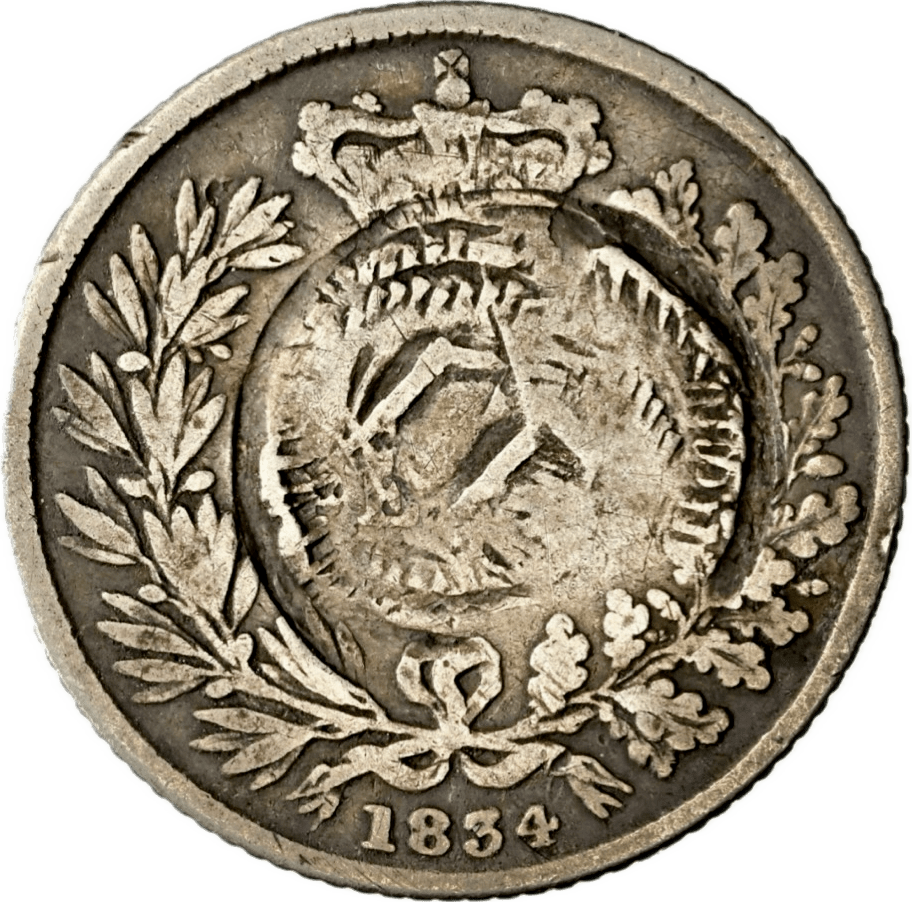
1834 William IV sixpence — study specimen investigated in this project.
NOW PUBLISHED — 24 SEPTEMBER 2026
Project 001 has reached peer-reviewed publication in npj Heritage Science (Nature Portfolio).
A. Ikraam, “Laboratory investigation of a deformed 1834 William IV sixpence.”
The study presents independently commissioned microscopy, chemical analysis and three-dimensional surface measurements of the severely deformed 1834 British silver sixpence.
The physical evidence is most consistent with a severe mint-stage striking anomaly rather than ordinary wear, corrosion or a single unconstrained later impact.
The investigation also documents human-supervised AI-assisted hypothesis development before independent laboratory testing. Independently produced measurements remained the primary scientific evidence, with final interpretation resting with the author.
Read the peer-reviewed paper →
Read the publication announcement →
DOI: 10.1038/s40494-026-02901-0
View the full Project 001 Public Research Record →
Watch the investigation
Watch the 1834 Sixpence Investigation
A short visual overview of Project 001, from the coin’s unexpected discovery to the materials-science and human-supervised artificial-intelligence investigation.
Object Summary
Interpretation: Most consistent with a severe mint-stage striking anomaly
Analytical basis: Independent SEM–EDX and optical profilometry
Record status: Documented analytical study of this specimen
Analytical context: Case study combining computational exploratory analysis with independent laboratory measurement under human supervision.
Project 001 – The 1834 William IV Sixpence
A possible material record of an early industrial striking anomaly, preserved in silver.
A nineteenth-century manufacturing anomaly investigated through independent laboratory measurement, historical research, and structured computational analysis.
Two technological eras — one artefact.
The specimen is interpreted as preserving material evidence most consistent with a severe mint-stage striking anomaly from the mechanised steam-press era of British coinage.
Struck during the steam-press phase of mechanised coinage in 1834 and re-examined through modern materials analysis in 2025–2026, the coin was investigated using a hybrid workflow in which independently produced laboratory measurements were evaluated alongside structured computational analysis under full human supervision.
Independent analytical services incorporated:
• SEM–EDX — Experimental Techniques Centre, Brunel University London
• Optical surface profilometry — Oxford Materials Characterisation Service, Department of Materials, University of Oxford
Within the investigation, human-supervised large language model (LLM) and multimodal AI tools were used to organise imaging observations, support structured comparison, develop and challenge working hypotheses, and define questions for subsequent investigation before laboratory analysis. Contemporaneous records document this pre-laboratory AI-assisted work. The laboratory datasets were produced independently and remained the primary evidential constraint for interpretation.
Project 001 documents how exploratory computational reasoning was used before laboratory testing to organise observations and develop testable hypotheses, and how those hypotheses were subsequently evaluated against independently produced laboratory measurements. Following laboratory analysis, computational tools also supported structured organisation and comparison of the resulting datasets under human supervision.
Interpretive basis
Independent laboratory investigation informed the interpretation of the specimen. The project record summarises the investigation and should be read as a public overview rather than a detailed scientific report.
This interpretation is analytical; independently produced laboratory datasets provide the primary scientific evidence, considered alongside documented morphology and historical context.
The investigation illustrates how computational exploratory analysis can be used to formulate testable hypotheses that are subsequently evaluated against independently produced laboratory measurements.
For details of the analytical method applied, see: Methodology – Hybrid Reasoning Framework
Evidence Highlights
Mechanism plausibility
Pre-laboratory imaging and anomaly mapping generated multiple possible explanations for the deformation. Post-laboratory measurements constrained which mechanisms remained physically plausible.
Composition constraints
SEM–EDX provided non-destructive compositional information that was evaluated alongside the specimen’s morphology and surface condition.
Topographic signature
Optical profilometry provided three-dimensional surface measurements used to assess the scale and geometry of the deformation.
Peripheral preservation
Preserved rim structure and edge milling formed part of the evidence considered when evaluating possible deformation mechanisms.
Laboratory Analysis
Independent SEM–EDX analysis was conducted by Brunel University London Experimental Techniques Centre and optical surface profilometry by the University of Oxford Materials Characterisation Service. These independently produced measurements formed the principal evidential constraint for the investigation and informed the subsequent interpretation.
The laboratory measurements were evaluated alongside documented observations and historical context to assess the physical plausibility of several possible deformation mechanisms. The resulting interpretation is summarised in the associated project publications.
Structural indicators
Laboratory measurements identified structural features that were evaluated together with documented observations and historical context during interpretation.
Rarity of Surviving Examples
Severe mint-stage anomalies of comparable scale are rarely documented in nineteenth-century British coinage. During the early industrial period of British coin production, defective coins produced during mechanised striking were normally identified during mint inspection and returned to the melting process as scrap metal. This was particularly the case for precious-metal coinage, where the material itself retained recoverable value. As a result, most extreme striking failures would have been removed from circulation immediately. The survival of this specimen may represent unusual material evidence relevant to transient malfunction scenarios within mechanised minting systems of the period. Objects preserving deformation of this scale may provide unusual material evidence for the behaviour of early mechanised coining machinery.
Industrial Minting Context (c.1810–1840)
During the early nineteenth century the Royal Mint operated steam-powered coining machinery at the new Mint on Tower Hill following its relocation from the Tower of London in 1810. This equipment formed part of the wider industrialisation of British coin production associated with the innovations pioneered by Matthew Boulton at the Soho Mint and marked a major transition away from manually operated screw presses toward mechanised manufacture.
The Tower Hill presses belonged to an early generation of mechanised coining equipment and pre-dated the wider diffusion of Uhlhorn-type knuckle-lever presses, which began to spread from the 1820s onward. Contemporary and later technical accounts indicate that increasing degrees of automation in blank feeding and coin ejection formed part of this transition.
The historical context provides one possible framework within which the measured deformation can be interpreted. The project considers this alongside the laboratory observations rather than as direct historical proof.
No direct British archival record has been identified in the present investigation that documents this exact malfunction sequence or links it to a surviving distorted coin. The interpretation therefore rests on the measured morphology of the specimen and its mechanical consistency with steam-powered coining machinery operating during the mature phase of early mechanised British coin production.
Investigation Workflow
Project 001 followed a three-stage investigative workflow.
1 — Exploratory diagnostics (pre-laboratory)
High-resolution imaging, anomaly mapping, archival comparison, and computational analysis were used to document the specimen and generate testable hypotheses.
2 — Independent laboratory measurement
Non-destructive materials analysis was conducted by external laboratory facilities.
3 — Measurement-constrained interpretation
Laboratory datasets were evaluated alongside the earlier documentation to constrain the range of physically plausible mechanisms and inform the resulting interpretation.
Context and Significance
Mint-stage anomalies of comparable structural complexity are rarely documented in published nineteenth-century numismatic literature.
The investigation provides evidence relevant to understanding severe striking anomalies within the mechanised production environment of the period.
The specimen may therefore preserve a physical trace of industrial manufacturing behaviour within a mechanised minting system. Although originally produced as currency, the deformation preserved in the metal may record a transient mechanical disruption within the striking process.
Unlike more readily recognisable mint errors identified primarily by visual typology, this specimen was investigated through independent laboratory measurement and evidence-constrained interpretation to assess the likely origin of the deformation.
Beyond numismatics, the object can also be understood as a micro-scale record of machine behaviour preserved within a manufactured artefact.
Publications
Peer-reviewed scientific publication — 2026
Ikraam, A. (2026). “Laboratory investigation of a deformed 1834 William IV sixpence.” npj Heritage Science (Nature Portfolio).
DOI: 10.1038/s40494-026-02901-0.
Published 24 September 2026.
The paper presents the independently commissioned laboratory investigation and the author’s measurement-constrained interpretation of the specimen’s deformation.
Read the peer-reviewed paper →
Earlier public project account — 2025
Ikraam, A. (2025). “An 1834 William IV Sixpence with a Laboratory-Confirmed Multi-Strike Mint Error from the Steam-Press Era.” British Numismatic Society Research Blog.
This earlier project account was published following the independently commissioned laboratory investigation. The subsequent 2026 peer-reviewed npj Heritage Science paper retained the core mint-stage interpretation while refining the reconstruction of the deformation mechanism. For the current scientific interpretation of Project 001, the 2026 peer-reviewed npj Heritage Science paper should be treated as the principal scientific account.
Read the earlier British Numismatic Society account →
Public Engagement — From the Steam Age to AI
A short-form visual introduction to Project 001, produced for public engagement following publication of the peer-reviewed study in npj Heritage Science.
Acknowledgements
Independent laboratory analysis was commissioned from:
• Brunel University London — Experimental Techniques Centre
• University of Oxford — Materials Characterisation Service
These independently commissioned analytical services produced the SEM–EDX and optical profilometry measurements used in the investigation.
Record Note
Project 001 provides a documented analytical study of this specimen and served as the founding and developmental case study through which the IA STUDIO Hybrid Reasoning Framework was developed and subsequently formalised.
The documentation provides a reference point for future comparative study of severe mint-stage deformation in mechanised coinage and a methodological reference for the investigation of other complex heritage objects.
Status
Further supporting materials from Project 001 may be released subject to permissions, publication status and evidential governance.


You must be logged in to post a comment.