Human–AI collaboration
The IA STUDIO Hybrid Reasoning Framework is a formalised analytical framework for the investigation of cultural-heritage objects through documentary context, human-supervised computational analysis and independent laboratory measurement where feasible.
Developed through IA STUDIO’s first documented case study, Project 001 — The 1834 William IV Sixpence, and formalised as Edition 1.1 in January 2026, the framework establishes explicit boundaries between empirical measurement, documentary evidence, computational interpretive support and final human interpretation.
Computational and AI-assisted tools may support organisation of observations, structured comparison and hypothesis development under human supervision. Independently produced laboratory measurements provide the primary empirical constraint where available and relevant to the question under investigation.
Project 001 provided the documented developmental case from which the framework was subsequently formalised, demonstrating how laboratory science, historical research and human-supervised computational support can be integrated within a structured and traceable workflow for complex heritage-object investigation.
Institutions named on this page are referenced solely in relation to laboratory services or correspondence provided and do not imply endorsement of interpretation or classification.
Archival Record — Edition 1.1
Edition 1.1 of the IA STUDIO Hybrid Reasoning Framework was formalised and publicly announced in January 2026.
A fixed, citable archival record of Edition 1.1 was deposited in Zenodo on 3 October 2026.
Version DOI: 10.5281/zenodo.23117680
All-versions DOI: 10.5281/zenodo.23117679
The archival record incorporates editorial clarification and consolidation of the public presentation of Edition 1.1 while retaining its underlying methodological structure, evidential categories, human-supervision principles and evidence hierarchy.
Substantive future methodological developments will be documented through subsequent editions or publications rather than through silent alteration of the Edition 1.1 archival record.
Read the fixed Edition 1.1 archival record →
Overview
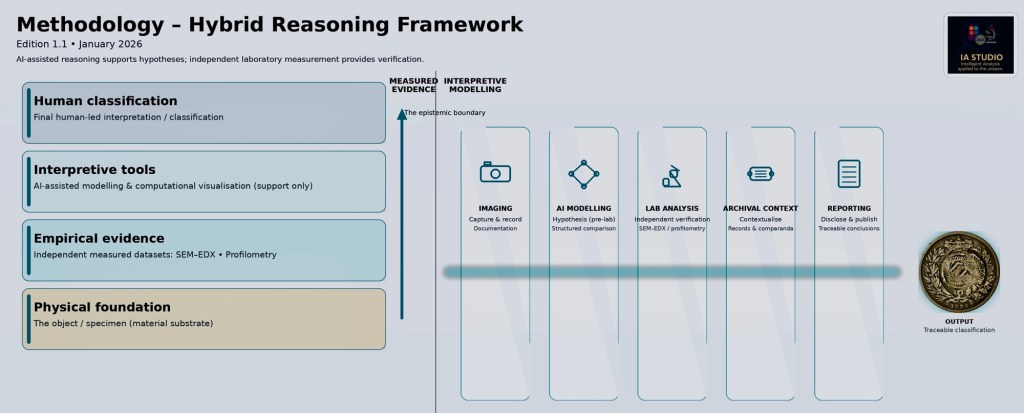
Figure (concept; illustrative): IA STUDIO Hybrid Reasoning Framework (Edition 1.1).
Illustrative only; not evidential material.
The IA STUDIO Hybrid Reasoning Framework is a formalised analytical framework for integrating human-supervised computational analysis with independently produced evidence in cultural-heritage investigation.
Its purpose is procedural rather than technological. It does not replace laboratory analysis, introduce a proprietary scientific instrument, or assign empirical status to computational interpretation. Instead, it defines how different kinds of evidence and analytical support are separated, recorded and brought together within a traceable object-based research workflow.
The framework is model-agnostic and is not tied to any particular AI system.
It is intended to support evidential hierarchy, interpretive traceability and clear separation between measured evidence and interpretive support in object-based research.
Evidential Structure
The framework operates through four differentiated evidential categories:
1. Measured laboratory evidence
Empirical datasets produced through independent scientific procedures, including non-destructive materials analysis and surface measurement.
2. Documentary evidence
Archival records, catalogues, historical references, and comparative materials providing contextual support.
3. Interpretive computational tools
Digital comparison, image-based review and AI-assisted support used for organisation of observations, structured comparison and hypothesis development under human supervision.
4. Interpretation and reporting
The final interpretation is developed through human evaluation of the available evidential layers, with clear distinction between measured evidence and interpretive support.
Where available and relevant to the question under investigation, independently produced laboratory measurements provide the primary empirical constraint.
Core Principle
IA STUDIO distinguishes clearly between measured evidence and interpretive support.
Computational and AI-assisted tools are used for organisation of observations, structured comparison, hypothesis development and interpretive support under human supervision. They do not generate laboratory measurements, perform the independent analyses, or autonomously determine the final interpretation.
Computational outputs are treated as provisional interpretive support and are not given evidential priority over independently produced measurements. Where available and relevant to the question under investigation, independently produced laboratory measurements provide the primary empirical constraint.
Analytical Purpose
The framework was developed to support three linked aims:
• integration of computational tools without displacing empirical measurement
• explicit separation between exploratory modelling and empirical constraint
• traceable reporting of how observations, measurements, and interpretation relate to one another
Its function is to preserve clarity between what has been measured, what has been compared, and what has been inferred.
Workflow Stages
The framework operates across five broad stages:
1. Imaging and documentation
The object is recorded through high-resolution imaging, descriptive observation, and contextual note-taking.
2. Comparative and computational support
Digital comparison, surface review, and structured hypothesis formation are undertaken. Computational tools may be used at this stage under human supervision.
3. Laboratory analysis
Independent, non-destructive scientific testing is commissioned where feasible. Relevant datasets provide the primary empirical constraint for the physical questions they address.
4. Archival and historical contextualisation
Measured findings are considered alongside archival sources, typologies, historical references, and relevant comparanda.
5. Structured reporting
The final record presents the investigation with a clear distinction between measured evidence, documentary context, interpretive support and analytical conclusion.
Pre- and Post-Laboratory Application
The framework may be applied in both pre-laboratory and post-laboratory contexts.
In pre-laboratory stages, it supports structured observation, comparative review, and the development of testable hypotheses.
In post-laboratory stages, it supports the organisation and interpretation of measured results while preserving the evidential priority of independently produced datasets.
This two-stage application allows interpretive continuity without collapsing the distinction between exploratory reasoning and empirical constraint.
Empirical constraint narrows the range of physically plausible interpretations but does not eliminate interpretive uncertainty. Further evidence, comparison or expert review may support additional evidence-led refinement where warranted.
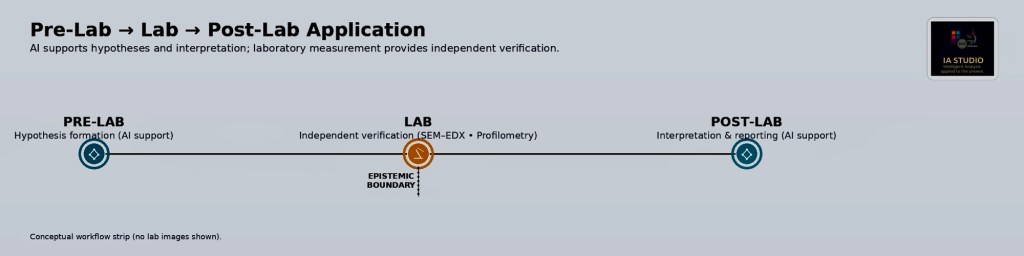
Figure (concept; illustrative): Pre-laboratory, laboratory, and post-laboratory application.
Illustrative only; not evidential material.
Development Through Project 001
The framework developed through the investigation of Project 001 — The 1834 William IV Sixpence.
In that case, high-resolution imaging, structured comparative review, and human-supervised computational analysis were undertaken before laboratory testing. Independently produced SEM–EDX and optical profilometry datasets were then used to evaluate the competing interpretive hypotheses developed during the earlier stages of the investigation.
The resulting workflow was later formalised as the IA STUDIO Hybrid Reasoning Framework.
Project 001 also clarified a broader methodological issue: when AI-assisted reasoning is used alongside laboratory measurement, the evidential role of each should remain explicit. The project’s development, and the later formalisation of the framework, informed its emphasis on traceability, evidential separation and evidence-led refinement.
The framework is therefore designed so that exploratory AI-assisted hypotheses can be progressively constrained by independently produced evidence without being confused with that evidence.
Project 001 therefore provides the documented developmental case through which the framework was developed and subsequently formalised.
Illustrative application
Project 001 provides an initial documented example of the framework’s sequencing. Human-led, computationally assisted working hypotheses and analytical observations were documented before independent laboratory testing. These pre-laboratory observations were subsequently considered alongside independently produced SEM–EDX and optical profilometry datasets within the documented workflow.
The case therefore illustrates how the framework supports structured exploratory reasoning while keeping primary evidential weight with independently produced laboratory measurement.
Transparency Note
The IA STUDIO Hybrid Reasoning Framework is presented as a documented analytical framework for transparency and scholarly reference.
It is intended to clarify evidential hierarchy within interdisciplinary investigation and to preserve an explicit distinction between empirical measurement, documentary support, interpretive tools, and final analytical conclusion.
Edition 1.1 represents the current formalised version of the framework. Any substantive future methodological developments will be documented through subsequent editions or publications.
Edition 1.1 has not yet undergone separate peer-reviewed methodological validation across multiple investigations. Project 001 provides the documented developmental case from which the framework was formalised, while future applications will allow its broader applicability and limitations to be evaluated.
Further Methodological Work
Project 001 provided the documented developmental case for the IA STUDIO Hybrid Reasoning Framework. A future methodological publication is planned to examine the framework in greater detail, including pre-laboratory hypothesis development, empirical constraint, post-laboratory synthesis, evidence-led refinement and the role of human supervision across successive stages of analysis.
More granular implementation details from Project 001 are being retained for continuing methodological research and future scholarly publication. Future case studies will provide opportunities to evaluate the application of Edition 1.1 and may inform clearly documented future editions, while maintaining the same commitment to evidential transparency and the primacy of independently produced laboratory measurements where available.
Scope and responsibility
IA STUDIO operates as an independent heritage science research initiative.
Outputs are documented for reference and transparency and do not imply institutional endorsement. Interpretations are intended to be constrained by independently produced scientific measurements where available and developed through transparent human evaluation of the wider evidential record.
Citation Guidance
When citing the fixed Edition 1.1 archival record, please use:
Ikraam, A. (2026). IA STUDIO Hybrid Reasoning Framework — Edition 1.1: Archival Record (Version 1.1). Zenodo.
DOI: 10.5281/zenodo.23117680
For citation of the framework across all current and future repository versions, the Zenodo all-versions DOI is: 10.5281/zenodo.23117679
Framework Record
Edition 1.1 was formalised and publicly announced in January 2026, having been developed through Project 001 as its documented developmental case.
A fixed archival record of Edition 1.1 was deposited in Zenodo on 3 October 2026 under DOI 10.5281/zenodo.23117680.
Edition 1.1 should now be treated as a stable methodological record. Future substantive changes will be documented through subsequent editions or publications.


You must be logged in to post a comment.