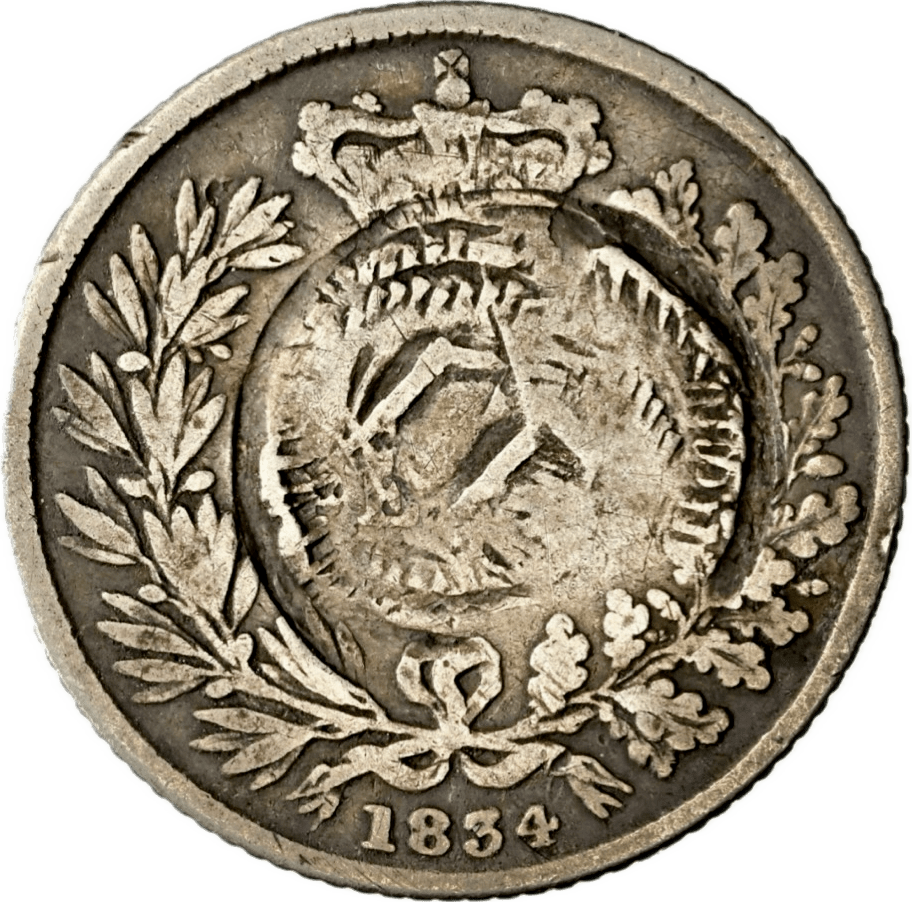
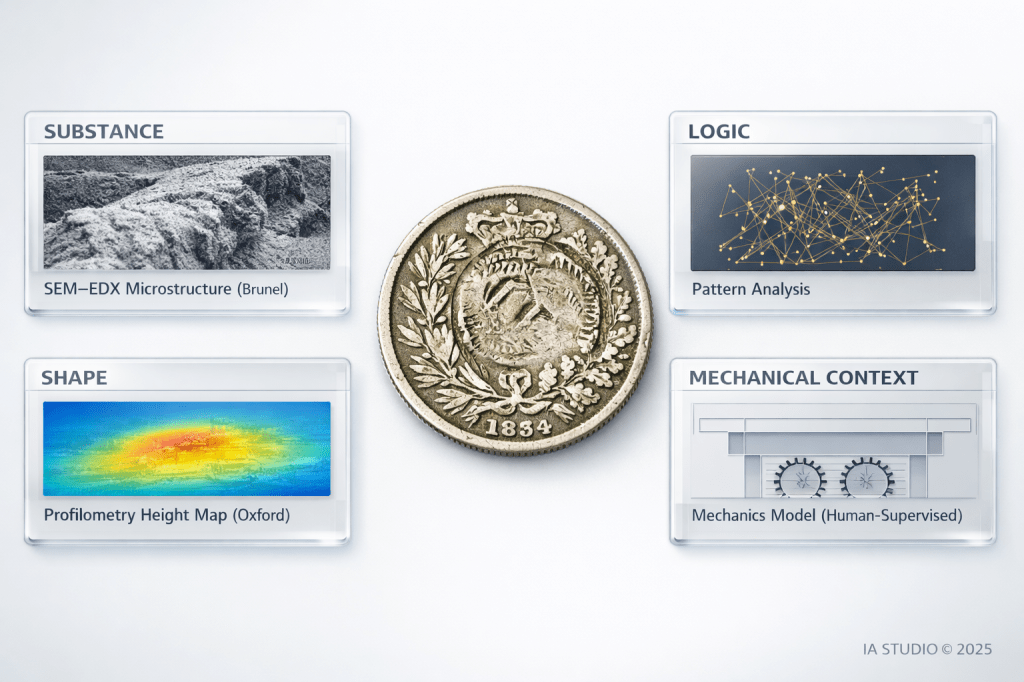
1834 William IV sixpence — study specimen investigated in this project.
A nineteenth-century manufacturing failure, reconstructed nearly two centuries later through independent laboratory measurement and AI-assisted analysis.
Two technological eras, one artefact.
In effect, the specimen preserves a rare physical record of a momentary malfunction within the striking cycle of a nineteenth-century steam-powered coining press, now reconstructable through modern materials analysis.
Struck during the steam-press phase of mechanised coinage (1834) and re-examined using modern AI-assisted scientific investigation (2025–2026), this sixpence was examined through a hybrid workflow: independently produced laboratory measurements (SEM–EDX and optical profilometry) evaluated alongside structured, AI-assisted comparative analysis under full human supervision.
What “AI-assisted” means here: AI tools were used to organise observations from enhanced imaging, map anomalies, and define testable hypotheses and measurement targets prior to laboratory access. The laboratory datasets were produced independently and provide the empirical constraint for interpretation.
Project 001 demonstrates how AI-assisted exploratory reasoning can be structurally separated from empirical evidence through a workflow in which hypotheses derived from imaging and comparative analysis are evaluated against independently produced laboratory measurements.
The investigation was conducted under the IA STUDIO Hybrid Reasoning Framework, using human analytical reasoning supported by structured computational tools, in conjunction with independent laboratory verification.
AI is not a replacement for the laboratory — it’s a bridge to it.
Key Result
Independent laboratory measurements (SEM–EDX; optical profilometry), evaluated against pre-laboratory imaging and comparative analysis, indicate the specimen is consistent with a severe mint-stage multi-strike striking anomaly produced during mechanised steam-press coinage in which the coin remained laterally constrained within the striking collar during successive compressive events.
This summary is interpretive; primary evidence is the independently produced laboratory datasets.
In mechanical terms, the coin most plausibly records a collar-constrained multi-strike failure in which the sixpence failed to eject from the steam-powered press and received multiple successive blows while still inside the striking chamber.
For details of the analytical method applied, see: Methodology – Hybrid Reasoning Framework
Evidence highlights (measurement-constrained):
- Mechanism plausibility: Pre-laboratory imaging and structured anomaly mapping generated competing hypotheses; post-laboratory SEM–EDX and optical profilometry constrained which mechanisms remained physically plausible.
- Composition constraints: SEM–EDX supported a silver–copper alloy consistent with period coinage, with minor elements consistent with surface-associated products rather than a foreign insert.
- Topographic signature: Optical profilometry quantified severe, localised deformation and step/terrace-like relief changes consistent with repeated high-pressure events under constraint, rather than a single post-mint impact.
- Collar constraint indicator: Preservation of rim structure and edge milling indicates that lateral metal flow remained confined during deformation, demonstrating that the coin remained within the striking collar while the central fields experienced repeated compressive blows.
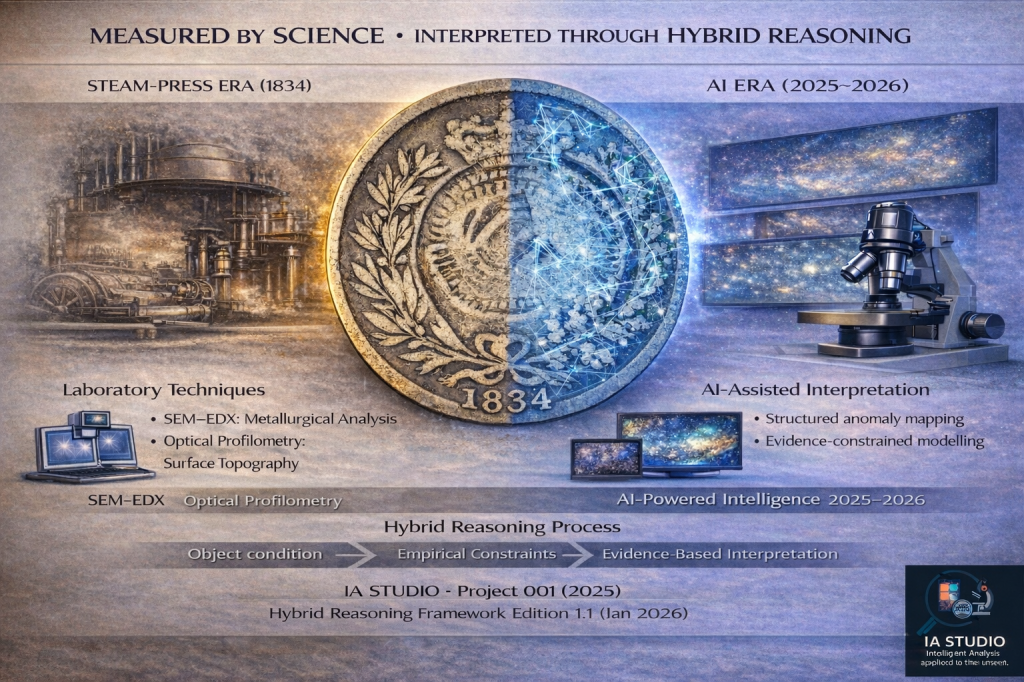
SEM–EDX analysis (Brunel University London – Experimental Techniques Centre)
Scanning Electron Microscopy with Energy Dispersive X-ray Spectroscopy (SEM–EDX) confirmed a silver–copper composition consistent with nineteenth-century sterling coinage. Elemental variation observed within the most heavily affected central regions—including elevated copper together with sulphur, iron, carbon, oxygen, and minor environmental elements—is consistent with surface contamination or corrosion products accumulated within mechanically formed depressions rather than with the presence of foreign metal or an anomalous alloy. The irregular cavities visible on the obverse are most plausibly interpreted as mechanically disrupted and locally collapsed surface recesses formed during the strike failure, with subsequent localised corrosion or contaminant accumulation accentuating the damaged zones.
Microscopic examination showed the most severe disturbance concentrated in the central fields, while the outer circumferences remain comparatively intact. Localised depressions and compressive surface features are present within the damaged zones; typical post-mint wear would more commonly present as distributed abrasion, scratches, or deep striations. The observed surface morphology is therefore consistent with deformation produced under compressive loading rather than with typical circulation damage.
Optical profilometry (University of Oxford – Materials Characterisation Service)
High-resolution optical profilometry mapped the micro-topography of both obverse and reverse surfaces using dense height-grid datasets. The measurements document extreme relief displacement within the central fields, including sharp-edged troughs, raised shoulders, and multi-step terracing.
Across the denomination area, repeated overlapping displacements have largely effaced the word “SIXPENCE”, leaving only faint residual traces of the lettering. The resulting morphology—including terraced deformation, arcuate depressions with steep shear boundaries, and redistributed metal-flow structures—is consistent with repeated compressive events occurring while the coin remained constrained within the striking environment. These features indicate plastic deformation with local outward displacement of material from the compression centres during successive collar-constrained strikes.
The terraced surface morphology and overlapping deformation layers indicate sequential high-pressure strike events rather than deformation produced by a single mechanical impact.
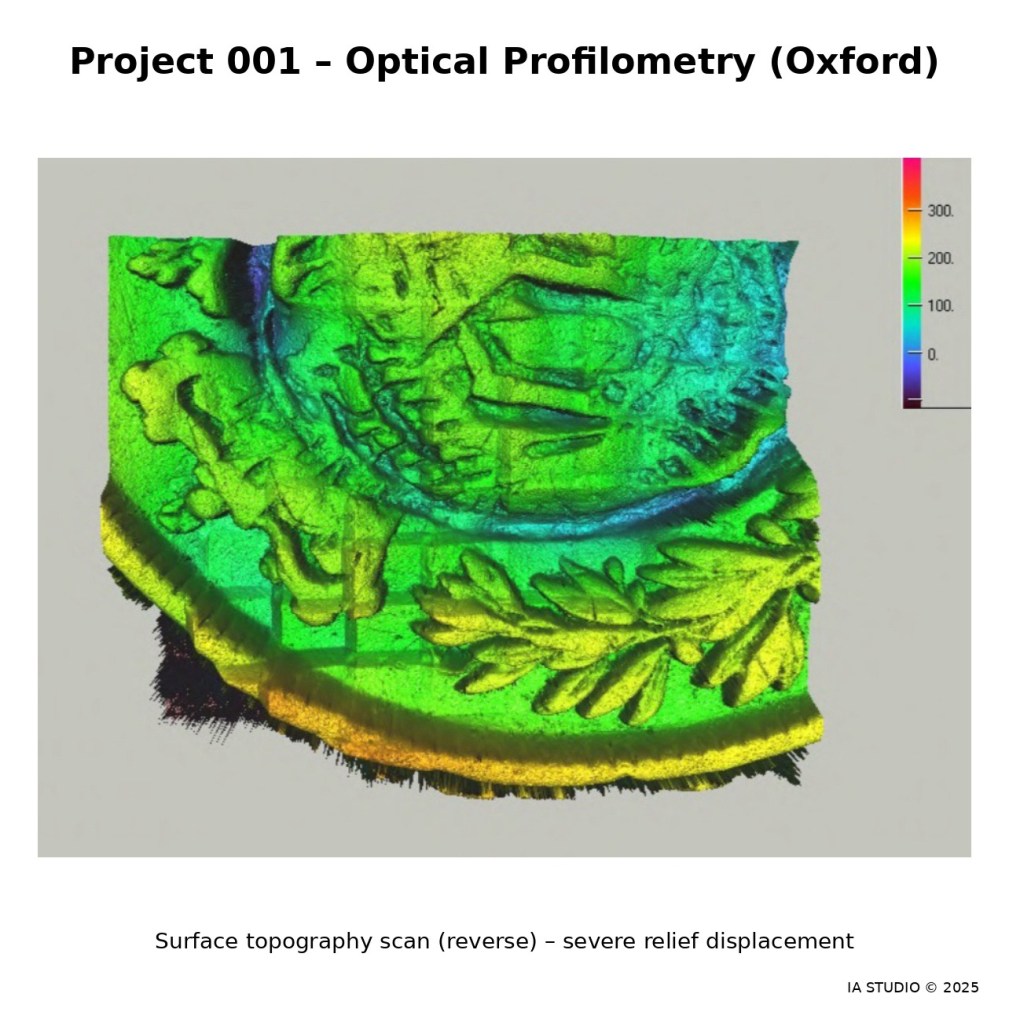
Surface topography map (reverse): severe relief displacement and terraced deformation consistent with repeated compressive events.
Interpretive context
When evaluated together with the preserved edge milling, the intact peripheral regions, and the absence of compositional anomalies, these independently produced laboratory measurements are consistent with deformation produced during mint-stage striking rather than with later mechanical damage.
Within Project 001, these findings were evaluated alongside pre-laboratory imaging, anomaly mapping, and archival comparison. The combined evidential record supports classification of the specimen as a severe mint-stage multi-strike striking anomaly, exhibiting characteristics consistent with a retained or destabilised coin during the strike cycle, with possible die-cap or strike-through interaction during the later stages of deformation.
Methodological note
Independent laboratory measurements provide the empirical constraints for interpretation; classification of the specimen as a mint-stage anomaly represents an analytical conclusion reached within the IA STUDIO Hybrid Reasoning Framework based on the combined evidence.
Mechanical Reconstruction of the Strike Failure
The following reconstruction proposes the most plausible mechanical failure sequence based on the combined SEM–EDX and optical-profilometry datasets.
The deformation observed on the specimen is most consistent with a severe mint-stage multi-strike failure within a collar-constrained striking environment rather than with post-mint damage or metallurgical defect.
Optical profilometry documents terraced relief displacement, sharp-sided troughs, raised shoulders, and overlapping deformation layers within the central fields, indicating successive high-pressure compressive events acting on material that remained laterally constrained during striking. The most severe deformation occurs on the reverse, suggesting that this surface likely experienced the dominant compressive loading against the fixed opposing die during the failure sequence. The preserved outer rim and edge milling show that the coin remained within the striking collar during the failure sequence, strongly suggesting a press-cycle disruption such as incomplete ejection, feed instability, or temporary obstruction within the striking chamber. Such malfunctions remained mechanically plausible within mechanised steam-powered minting systems, even during the mature phase of steam-press coinage in the broader early-industrial period.
Taken together, the evidence indicates that the coin most plausibly failed to clear the striking chamber correctly and was struck repeatedly while still constrained within the collar. The deformation morphology records repeated compressive loading delivered by the moving hammer die, producing terraced displacement, overlapping strike layers, and misregistered compression fields consistent with limited positional shift between blows and possible slight rotational movement during the later stages of the strike sequence.
Rarity of Surviving Examples
Severe mint-stage failures of this type are rarely documented in nineteenth-century British coinage. This does not necessarily indicate that such events never occurred. Defective coins produced during mechanised striking were normally identified during mint inspection and returned to the melting process as scrap metal. As a result, most extreme striking failures would have been removed from circulation immediately.
The survival of this specimen therefore represents an unusual physical record of a transient press malfunction that would normally have been eliminated during routine mint quality control.
Overview
Project 001 investigates a severely deformed 1834 William IV sixpence presenting atypical structural characteristics not readily addressed by conventional visual or commercial assessment alone.
Prior to independent laboratory analysis, differing interpretations highlighted the limitations of purely visual evaluation and motivated empirical, materials-based investigation.
Through independently commissioned laboratory testing and detailed documentation, the study concludes that the specimen is consistent with a severe mint-stage multi-strike striking anomaly produced during mechanised coinage.
This case documents the initial analytical model intended to inform subsequent IA STUDIO investigations.
Project 001 serves as the initial demonstration of the IA STUDIO Hybrid Reasoning Framework, providing a documented methodological foundation for further heritage analyses.
The specimen preserves a physical record of a nineteenth-century steam-press malfunction. Modern laboratory measurement and structured analytical reasoning allow that event to be investigated nearly two centuries later.
Investigation Workflow
Project 001 followed a three-stage investigative workflow:
- Exploratory Diagnostics (Pre-Laboratory)
High-resolution imaging, anomaly mapping, archival comparison, and AI-assisted structured analysis were used to identify and document unusual structural features. - Independent Laboratory Measurement
Non-destructive materials analysis was conducted by external facilities:
- Brunel University London – SEM–EDX
- University of Oxford – Optical profilometry
3. Measurement-Constrained Interpretation
Laboratory results were evaluated alongside the pre-laboratory observations to determine which proposed mechanisms remained physically plausible.
Laboratory Validation
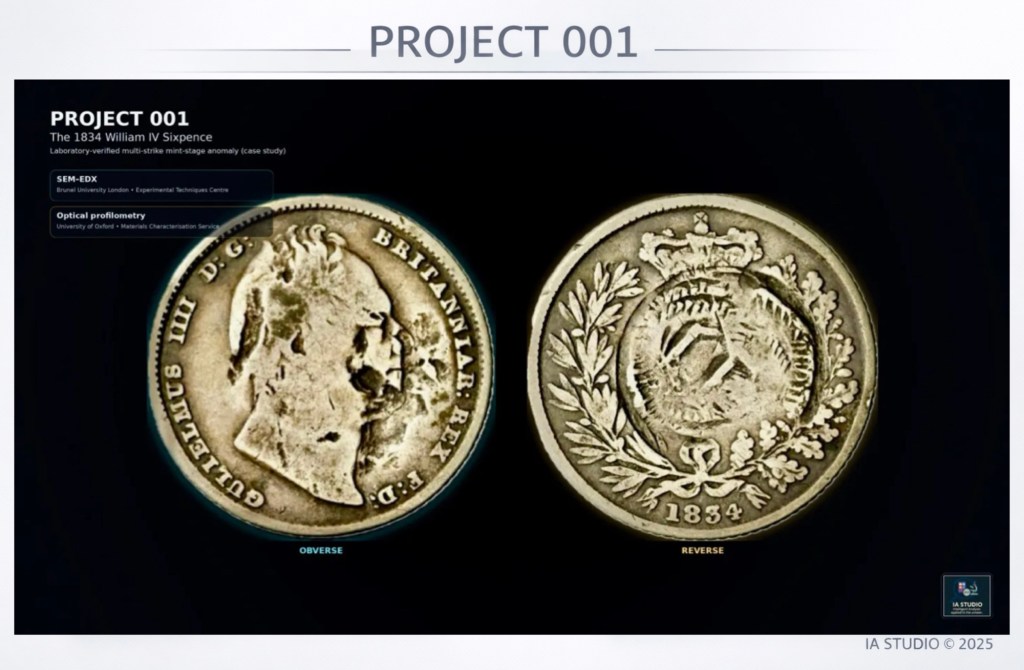
Independent, non-destructive analysis incorporated:
• Brunel University London – SEM–EDX (Experimental Techniques Centre)
• University of Oxford – Optical profilometry (Materials Characterisation Service)
These analyses documented alloy consistency and surface deformation features compatible with repeated in-die striking processes.
All laboratory work was performed independently; IA STUDIO’s role was limited to documentation, interpretation, and correlation of results within the research framework.
Method Summary
The investigation combined:
• High-resolution imaging and documentation
• Comparative assessment against standard 1834 sixpence types
• Digital surface study and structured comparative analysis (interpretive support using computational tools where applicable)
• Archival and reference checks (catalogues and published sources)
• Independent laboratory measurement (primary evidential layer)
AI-assisted tools were used only for structured comparison and interpretive modelling. Laboratory outputs (SEM–EDX and optical profilometry) remain the primary evidential foundation.
Interpretation (summary)
Taken together, the independent SEM–EDX and optical-profilometry datasets, evaluated alongside pre-laboratory imaging and comparative analysis, support classification consistent with a severe mint-stage multi-strike striking anomaly. Confirmatory weight rests with the independently produced laboratory measurements; the classification represents an analytical conclusion reached within the IA STUDIO Hybrid Reasoning Framework.
Context & Significance
Mint-stage anomalies of comparable structural complexity are rarely documented in published nineteenth-century British numismatic literature.
The findings demonstrate that even within the mature phase of steam-powered coining in the 1830s, extreme striking failures could occur under specific production conditions.
By integrating materials science, imaging technology, computational modelling, and archival study – with AI-assisted interpretive support – Project 001 establishes a transparent, evidence-based model for examining complex minting phenomena.
This case documents how structured exploratory assessment conducted prior to laboratory testing was subsequently evaluated against independently produced laboratory measurements.
For context on how this case contributed to IA STUDIO’s research framework, see: About IA STUDIO
The case therefore provides a documented example of how exploratory analysis conducted prior to laboratory testing can be transparently evaluated against independently produced scientific measurements.
Why This Matters
Produced during the steam-press era of mechanised coinage (1834) and investigated using modern laboratory measurement with AI-assisted interpretation (2025–2026), Project 001 demonstrates how complex historical artefacts can be re-examined through an evidence-first workflow. The case separates exploratory modelling from empirical validation, keeping confirmatory weight with independently produced scientific datasets.
Publication Reference
Ikraam, A. (2025).
An 1834 William IV Sixpence with a Laboratory-Confirmed Multi-Strike Mint Error from the Steam-Press Era.
British Numismatic Society – Research Blog (2025)
BNS Research Blog: Full publication (2025)
A courtesy copy of the research publication was provided to The Royal Mint Museum. The Museum confirmed receipt and stated that a copy would be held in its records (November 2025).
Acknowledgements
Independent laboratory analysis was commissioned from:
• Brunel University London – Experimental Techniques Centre (ETC)
• University of Oxford – Materials Characterisation Service (OMCS)
IA STUDIO gratefully acknowledges their contribution to the non-destructive scientific examination of the specimen.
This study forms the evidential foundation for IA STUDIO’s continuing research model and demonstrates how verified scientific measurement can substantiate historical interpretation.
Reference Record
Project 001 establishes the first fully documented analytical record of this specimen, integrating independent laboratory measurement with structured interpretive analysis under the IA STUDIO Hybrid Reasoning Framework. This documentation provides a permanent reference point for future comparative study of severe nineteenth-century steam-press minting anomalies.
Status
Selected imaging panels, surface maps, and summary datasets from Project 001 are scheduled for controlled release in 2026 under IA STUDIO’s transparency-first, non-commercial access policy.
At present, IA STUDIO’s work remains focused on research and documentation. Any future custodial, exhibition, or valuation arrangements will be considered only within an evidence-based, transparency-first governance framework.
The methods developed in this project underpin IA STUDIO’s ongoing research framework.
Research Approach
IA STUDIO operates as an independent research and documentation initiative focused on the analytical investigation of historically significant objects.
The framework applied in Project 001 separates exploratory reasoning, computational support, and independent laboratory measurement to maintain clear evidential boundaries within the investigative process.
FAQ
Does IA STUDIO offer valuations or grading services?
No. IA STUDIO operates solely as a research and documentation initiative.
Can I submit an object for study?
At present, investigations are initiated internally and by invitation only.
Terminology & Historical Context
In this study, the term “early” refers to the early industrialisation of Britain’s mechanised minting (c. 1810–1840), rather than the initial decade of steam-press use.
William IV coinage (1831–1837) therefore represents the mature phase of steam-press minting within the broader early-industrial period of coin production.
For the official archival record and publication summary of this study, see: IA STUDIO – Official Statement No. 001
Edition 1.1 – January 2026
This edition documents the analytical and interpretive record of Project 001 as consolidated in January 2026.
It documents the case study used to develop the IA STUDIO Hybrid Reasoning Framework and its application to a laboratory-verified mint-stage anomaly.
Future updates will coincide with the scheduled release of supporting imaging datasets and transparency materials later in 2026.
 IA STUDIO
You must be logged in to post a comment.