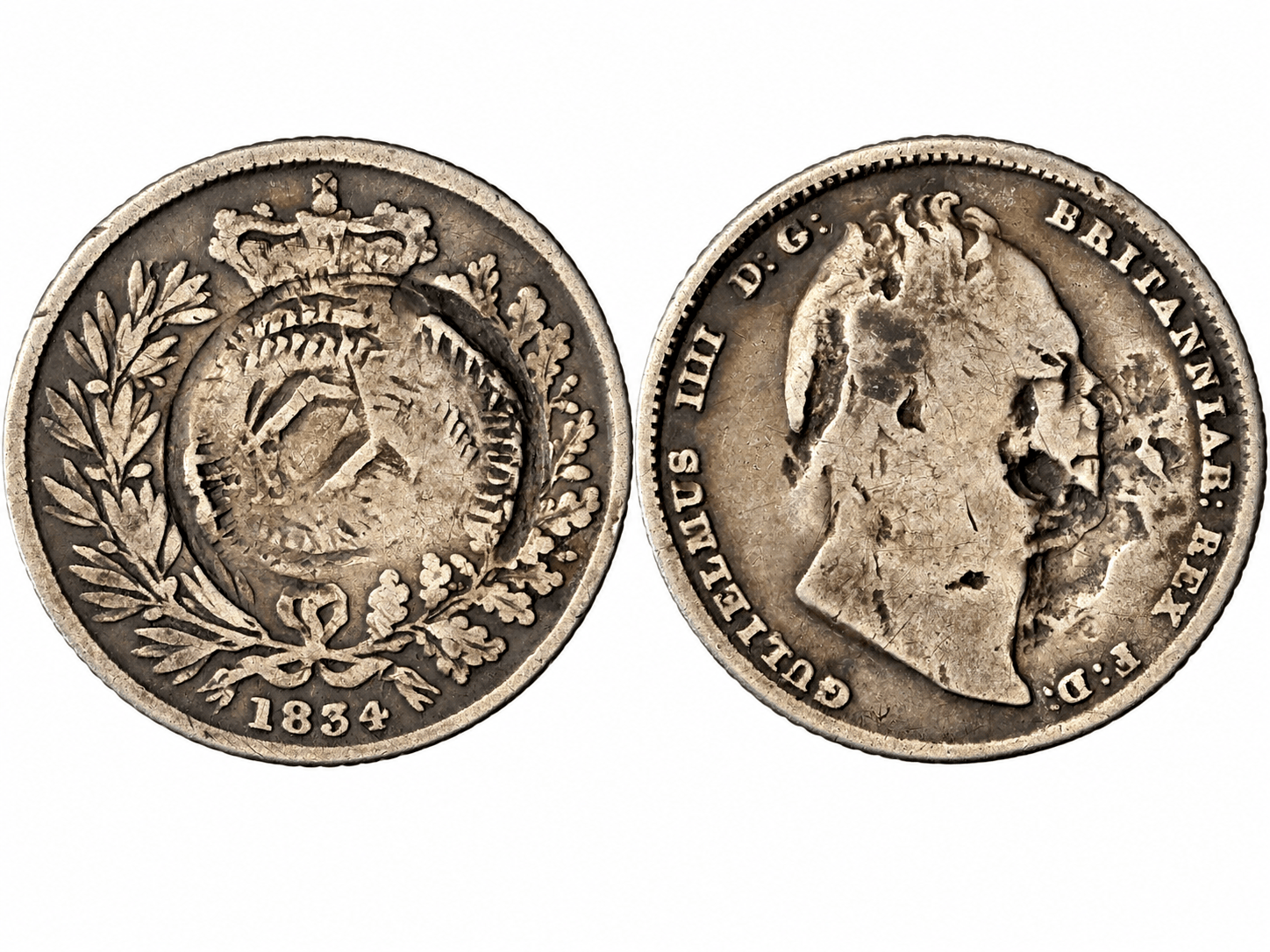
Independent laboratory evidence favours a severe mint-stage striking anomaly in an 1834 British sixpence, following a human-led, AI-assisted investigation.
IA STUDIO announces the publication of Project 001 in the peer-reviewed journal npj Heritage Science (Nature Portfolio).
The paper, “Laboratory investigation of a deformed 1834 William IV sixpence,” by A. Ikraam, presents a non-destructive scientific investigation of a severely deformed British silver coin from the early mechanised era of British coin production.
The findings favour an unusual mint-stage striking anomaly over ordinary wear, corrosion or a single unconstrained later impact.
From an unexpected discovery to scientific investigation
The sixpence was discovered in a mixed coin album at a car boot sale in Greater Manchester, where it was individually marked £8 in a stapled plastic coin holder. The album was subsequently acquired as a job lot, rather than the coin being purchased separately at its marked price.
The holder was opened after acquisition to allow further examination of the specimen.
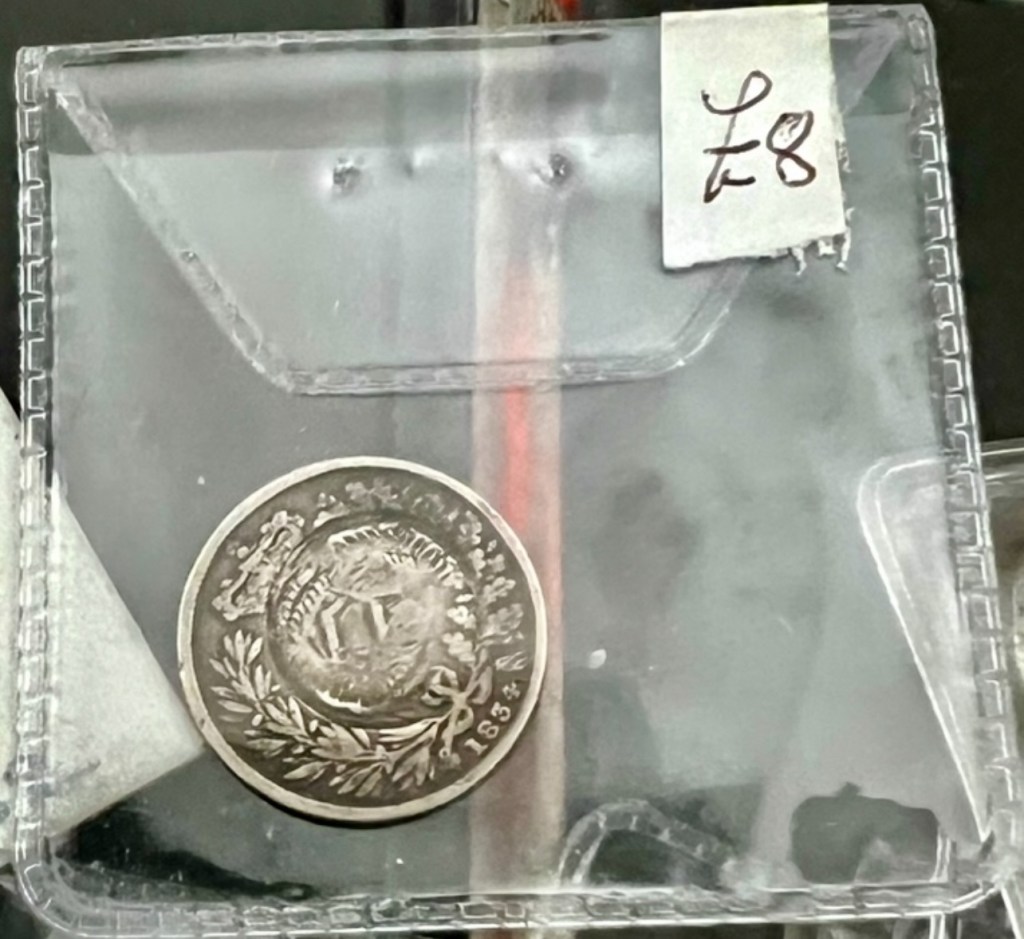
The sixpence as documented in its stapled plastic coin holder, showing the handwritten £8 marking. The album was acquired as a job lot, and the holder was opened after acquisition for further examination. Photograph: A. Ikraam / IA STUDIO.
Earlier image-based assessments had generally interpreted the coin’s severe deformation as damage sustained after minting. That uncertainty prompted a more detailed investigation through IA STUDIO’s Project 001.
Reading the evidence in the metal
The investigation combined scanning electron microscopy with energy-dispersive X-ray spectroscopy (SEM-EDX) and optical surface profilometry.
Non-destructive analytical services were independently commissioned from the Experimental Techniques Centre at Brunel University of London and the Oxford Materials Characterisation Service, Department of Materials, University of Oxford.
The measurements documented severe deformation concentrated in the central fields of the coin, while substantial portions of its rim and edge milling remain comparatively preserved.
Analysis by the author of the Oxford surface-height data identified approximately 0.75 millimetres of vertical relief variation in the damaged central portrait region on the obverse.
Taken together, the chemical, microscopic and topographic evidence is most consistent with severe localised deformation involving repeated high-pressure loading under at least partial lateral constraint.
The published study favours a severe mint-stage striking anomaly. It does not claim to reconstruct every mechanical step that produced the deformation or exclude every possible later constrained-compression scenario.
Two technological eras — one artefact
The sixpence was struck in 1834, during Britain’s steam-press era of coin production.
Severe striking failures in precious-metal coinage were ordinarily removed during mint inspection and remelted. If the study’s interpretation is correct, this specimen may preserve unusual surviving evidence of an abnormal event during early mechanised manufacture.
Nearly two centuries later, Project 001 brought together historical investigation, digital documentation, independent laboratory measurements and human-supervised computational tools, including AI, to revisit the evidence preserved in its metal.
The human–AI investigation
Human-supervised AI tools helped organise observations, compare alternative explanations and formulate questions before the independent laboratory measurements became available.
Working hypotheses and analytical notes were documented during this earlier phase.
Following laboratory testing, computational tools also supported the organisation and comparison of the independently produced measurements against those hypotheses.
The AI tools did not generate the laboratory measurements or determine the study’s conclusion. The physical datasets remained the primary scientific evidence, and responsibility for interpretation and final judgement rested with the author.
Project 001 subsequently became the founding case study for the separately documented IA STUDIO Hybrid Reasoning Framework, formalised in January 2026.
The two independent laboratory facilities provided commissioned analytical services. Their involvement does not imply institutional authorship or endorsement of the study’s interpretation or computational methodology.
Read the published research
Paper: Laboratory investigation of a deformed 1834 William IV sixpence
Journal: npj Heritage Science (Nature Portfolio)
Author: A. Ikraam
Affiliation: IA STUDIO — Independent Heritage Science Research Initiative
Publication date: 24 September 2026
DOI: 10.1038/s40494-026-02901-0
Read the peer-reviewed paper →
Read the public EurekAlert news release →
Read the official Project 001 research record →
Media and academic enquiries: contact@iastudio.org


You must be logged in to post a comment.