Project 001 – Public Research Record
Issued: 20 November 2025 | Last updated: 17 October 2026
PEER-REVIEWED PUBLICATION – 24 SEPTEMBER 2026
Project 001 was published in the peer reviewed journal npj Heritage Science on 24 September 2026.
A. Ikraam, “Laboratory investigation of a deformed 1834 William IV sixpence.”
The paper presents independently commissioned laboratory measurements and the author’s interpretation of the specimen’s deformation. The combined physical evidence favours a severe mint-stage striking anomaly rather than ordinary wear, corrosion or a single unconstrained later impact.
Read the peer-reviewed paper →
Read the IA STUDIO publication announcement →
DOI: 10.1038/s40494-026-02901-0
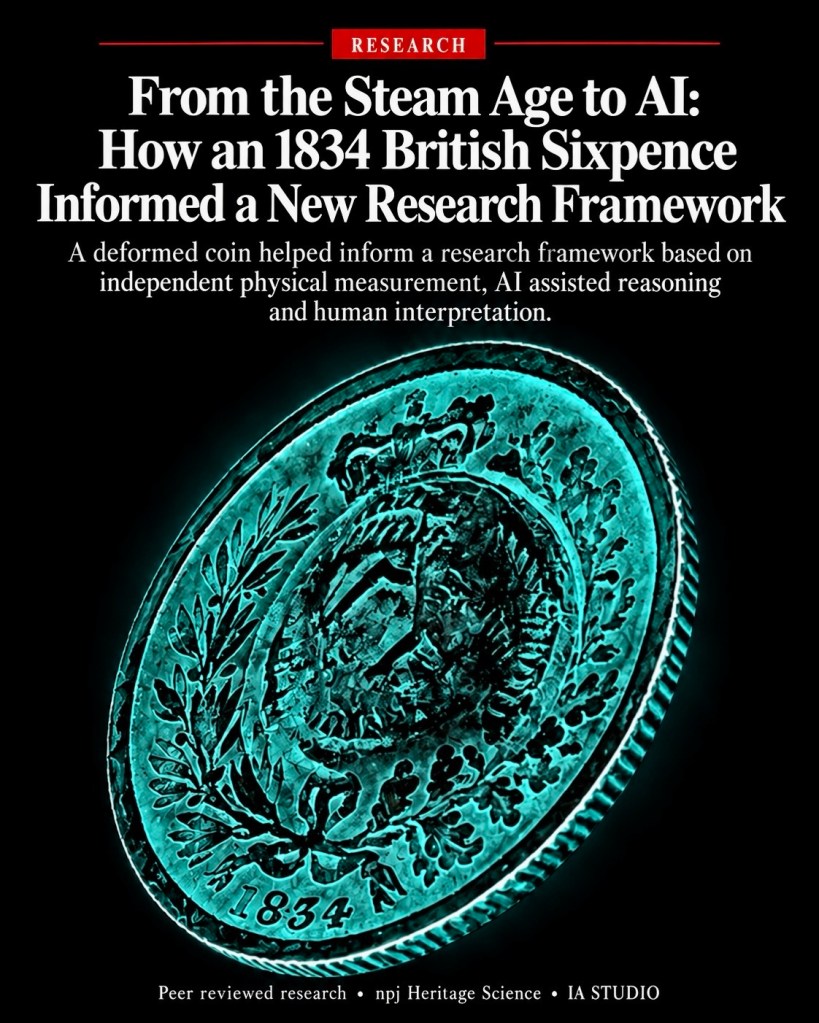
Watch the investigation
Watch the 1834 Sixpence Investigation
A short visual overview of Project 001, from the coin’s unexpected discovery to the materials-science investigation supported by human-supervised AI-assisted analysis.
Media Coverage
Following publication, Project 001 received coverage across science, technology, archaeology and history media in the UK and internationally. Selected coverage and commentary include elDiario.es, Hi-Tech Mail, Phys.org, O Antagonista, Archaeology News, Naked Science, Aventuras na História, T4, Socportal, Nordisch.info, HistoryLibrary, Hatena Blog and BusinessMole, with further adaptations and secondary distribution across additional platforms.
Featured Interview — AI, Evidence and Human Oversight
On 15 October 2026, AI Gossips published an exclusive interview with A. Ikraam examining the AI-methodology dimension of Project 001.
“When AI Is Not Evidence: An Interview with A. Ikraam on Hybrid Reasoning in Heritage Science” explores how human-supervised AI-assisted reasoning was used to organise observations and compare hypotheses, while independently produced laboratory measurements remained the primary scientific evidence.
The interview was published in English and Arabic.
Project 001 documents the investigation of a severely deformed 1834 William IV sixpence using independently produced non-destructive laboratory measurements, structured documentation and historical contextualisation.
The surviving evidence is interpreted as most consistent with a severe mint-stage striking anomaly associated with the mechanised steam-press era of nineteenth-century British coin production.
Computational and AI-assisted tools were used under human supervision for structured comparison, hypothesis development, organisation of observations and preparation of analytical material. They did not generate laboratory measurements or independently determine the interpretation. Primary evidential weight rests with independently produced laboratory data and associated documentation.
Contemporaneous pre-laboratory records document the use of human-supervised AI-assisted hypothesis development and structured analytical support before the independent SEM-EDX and optical profilometry measurements were obtained. These records establish the chronology of the exploratory reasoning process; the later physical measurements constrained the final interpretation.
This page provides a public project record and evidence timeline. It is intended as an overview rather than as a substitute for the detailed scientific publication.
Independent analytical services
Independent, non-destructive laboratory work commissioned by the author included:
Experimental Techniques Centre, Brunel University of London
SEM-EDX materials characterisation.
Oxford Materials Characterisation Service, Department of Materials, University of Oxford
Optical surface profilometry.
These were independently commissioned analytical services. Reference to the facilities does not imply institutional authorship or endorsement of the study’s interpretation.
Project summary
Project 001 investigated whether the unusual deformation of an 1834 William IV sixpence is better explained by mint-stage processes or later damage. Non-destructive SEM–EDX and optical surface profilometry provided the principal empirical constraint, considered alongside diagnostic imaging, historical context and structured comparison of competing explanations.
Working hypotheses and analytical notes were documented before the independent laboratory measurements became available. Post-laboratory interpretation was subsequently developed and evaluated against those datasets.
The project also examines manufacturing variability and possible failure modes associated with Britain’s mechanised minting era, while documenting how physical measurement, historical contextualisation and computational support can be combined in the investigation of disputed historical objects.
Evidence timeline
April 2025 — Preliminary external image-based assessments from numismatic, institutional and commercial sources generally interpreted the specimen as post-mint damage rather than as a mint-stage anomaly. This early scepticism informed the decision to pursue independent laboratory investigation.
April–May 2025 — Initial investigation and structured anomaly mapping were undertaken using high-resolution imaging, comparative assessment and human-supervised AI-assisted analytical support. Working hypotheses and analytical notes were documented before independent laboratory testing, with selected materials circulated externally during this pre-laboratory phase.
May 2025 — The specimen also underwent specialist in-hand assessment during the pre-laboratory phase. The proposed mint-stage interpretation was not accepted, and this contrary assessment was retained as part of the project record and provided further rationale for independent physical measurement.
June 2025 — Independent non-destructive SEM–EDX materials analysis was conducted through the Experimental Techniques Centre at Brunel University of London.
July 2025 — Independent non-destructive optical surface profilometry was conducted through Oxford Materials Characterisation Service, Department of Materials, University of Oxford.
August–September 2025 — Post-laboratory evaluation and structured interpretation of the measurement datasets were undertaken, including human-supervised computational organisation and comparison with the pre-laboratory hypotheses.
November 2025 — An earlier post-laboratory account of Project 001, authored by A. Ikraam, was published through the British Numismatic Society Research Blog. It used a more specific mechanical reconstruction than the subsequent peer-reviewed formulation, which retained the mint-stage interpretation while placing tighter limits on reconstruction of the exact deformation sequence.
December 2025 — The E-Sylum published a reader contribution by A. Ikraam raising a methodological question about how numismatic researchers should distinguish laboratory-based evidence from interpretive or assistive tools, including AI, so that the evidential basis of conclusions remains clear to readers. Read the E-Sylum discussion →
January 2026 — Elements of the analytical workflow developed through Project 001 were formalised as the IA STUDIO Hybrid Reasoning Framework, Edition 1.1.
24 September 2026 — Project 001 was published in npj Heritage Science (Nature Portfolio) as “Laboratory investigation of a deformed 1834 William IV sixpence.” The paper presents independently commissioned SEM–EDX and optical profilometry measurements and the author’s measurement-constrained interpretation. The combined physical evidence favours a severe mint-stage striking anomaly while not claiming to reconstruct every mechanical step responsible for the deformation. Read the published paper →
3 October 2026 — A fixed archival record of the IA STUDIO Hybrid Reasoning Framework, Edition 1.1, was deposited in Zenodo for permanent scholarly citation and version control.
Version DOI: 10.5281/zenodo.23117680. — View archival record →
3 October 2026 — A Behind the Paper article by A. Ikraam was published through Springer Nature Research Communities, presenting the research journey behind Project 001 from pre-laboratory hypothesis development to independently produced physical measurement and evidence-constrained interpretation. The article also discusses the role of human-supervised AI-assisted reasoning and the subsequently formalised IA STUDIO Hybrid Reasoning Framework (Edition 1.1).
Read the Behind the Paper article →
15 October 2026 — AI Gossips published an exclusive English/Arabic interview with A. Ikraam examining the AI-methodology dimension of Project 001, including the distinction between AI-assisted interpretive support and independently produced scientific evidence. Read the interview →
Interpretive development
Project 001 documents an evidence-responsive progression from pre-laboratory hypothesis development through independent physical measurement to a more tightly bounded peer-reviewed interpretation. The final paper retained a severe mint-stage striking anomaly as the explanation best supported by the combined physical evidence while placing tighter limits on reconstruction of the exact mechanical sequence. This progression informed the framework’s separation of empirical measurement, documentary evidence, computational interpretive support and final human interpretation.
Publication record
Peer-reviewed scientific publication — 2026
Ikraam, A. (2026). “Laboratory investigation of a deformed 1834 William IV sixpence.” npj Heritage Science (Nature Portfolio).
Received 18 March 2026; accepted 1 July 2026; published 24 September 2026.
DOI: 10.1038/s40494-026-02901-0.
Read the peer-reviewed publication →
Earlier public research account — 2025
British Numismatic Society Research Blog
Ikraam, A. (2025). “An 1834 William IV Sixpence with a Laboratory-Confirmed Multi-Strike Mint Error from the Steam-Press Era.”
This earlier project account was published following the independently commissioned laboratory investigation. It used stronger and more specific mechanistic language than the subsequent peer-reviewed formulation. Through continued critical reassessment, the 2026 npj Heritage Science paper retained the core interpretation that a severe mint-stage striking anomaly is the explanation best supported by the combined physical evidence, while narrowing the proposed deformation mechanism and making the limits of that reconstruction more explicit. For the current scientific interpretation of Project 001, the 2026 peer-reviewed npj Heritage Science paper should be treated as the principal scientific account.
Read the earlier BNS Research Blog account →
Institutional correspondence
A courtesy copy of an earlier Project 001 research account was provided to the Royal Mint Museum in 2025. The Museum confirmed receipt and indicated that a copy would be retained in its records.
Following publication of the peer-reviewed study in npj Heritage Science, publication updates were sent to the Royal Mint Museum, the British Museum’s Department of Money and Medals, and the Science Museum Group’s Research & Public History team in September 2026.
This correspondence is recorded as part of the Project 001 chronology and does not imply institutional endorsement, assessment or adoption of the research or framework.
Valuation and provenance documentation
An independent insurance valuation of the specimen was obtained in March 2026 from a UK Chartered Arts and Antiques Surveyor (FRICS) for replacement-value scheduling purposes.
The valuation forms part of the Project 001 documentation and is not presented as a public sale estimate or prediction of market value.
IA STUDIO Hybrid Reasoning Framework
The framework was developed through Project 001 and subsequently formalised to distinguish empirical measurement, documentary evidence, computational interpretive support and final human interpretation within a structured and evidence-responsive workflow.
Public Engagement — From the Steam Age to AI
A short-form visual introduction to Project 001, produced for public engagement following publication of the peer-reviewed study in npj Heritage Science.
The film presents the 1834 William IV sixpence, modern materials analysis and the distinction between human-supervised AI-assisted reasoning and independently produced scientific evidence.
ERROR 1834 — The Coin Sang Back
In May 2026, IA STUDIO presented ERROR 1834 — The Coin Sang Back, a cinematic AI-assisted sound work inspired by Project 001.
The work introduced “The Singing Coin” as a public-facing cultural identity for the project. It is presented as cultural interpretation and public engagement rather than scientific evidence.
In June 2026, the ERROR 1834 short-form release surpassed 500,000 views on TikTok during its first public campaign.
Specialist publication The E-Sylum subsequently featured the work as a “soundscape celebration of numismatic investigation,” covering the TikTok release, YouTube soundtrack, IA STUDIO project record and wider cultural interpretation connected to Project 001.
Explore ERROR 1834 — The Coin Sang Back →
Read the June 2026 documentation update →
Related Documentation
The Experimental Techniques Centre at Brunel University London publicly referenced its SEM–EDX work on the Project 001 specimen in November 2025.
Further Work
Further Project 001 outputs and supporting documentation may be released subject to publication status, permissions and evidential governance.
For press or academic citation enquiries:
Project 001 serves as a documented case study linking historical-object investigation, independently produced laboratory measurement, historical contextualisation and human-supervised computational organisation.


You must be logged in to post a comment.