This page provides the official public documentation of the IA STUDIO Hybrid Reasoning Framework – a structured, transparent workflow that connects computational interpretation with verified laboratory evidence in numismatic and cultural-heritage research.
Institutions named on this page are referenced solely in relation to laboratory services or correspondence provided. They do not imply endorsement of interpretation, classification, or conclusions.
It formalises how AI-assisted exploratory reasoning can be responsibly integrated with independent laboratory verification under full human supervision.
Developed through IA STUDIO’s first documented case study (Project 001: The 1834 William IV Sixpence), the framework defines how analytical reasoning, digital modelling, and independent scientific validation operate together within a reproducible research process.
It serves as both a methodological reference and a transparency record for future IA STUDIO investigations.
While “hybrid reasoning frameworks” exist more broadly in AI research, the IA STUDIO Hybrid Reasoning Framework represents a field-specific adaptation for cultural-heritage analysis, combining human-led interpretation with computational modelling verified through independent laboratory evidence.
Edition 1.1 – January 2026
This edition consolidates the documented structure and methodological principles of the IA STUDIO Hybrid Reasoning Framework, informed by independent laboratory analysis, as of January 2026.
Overview
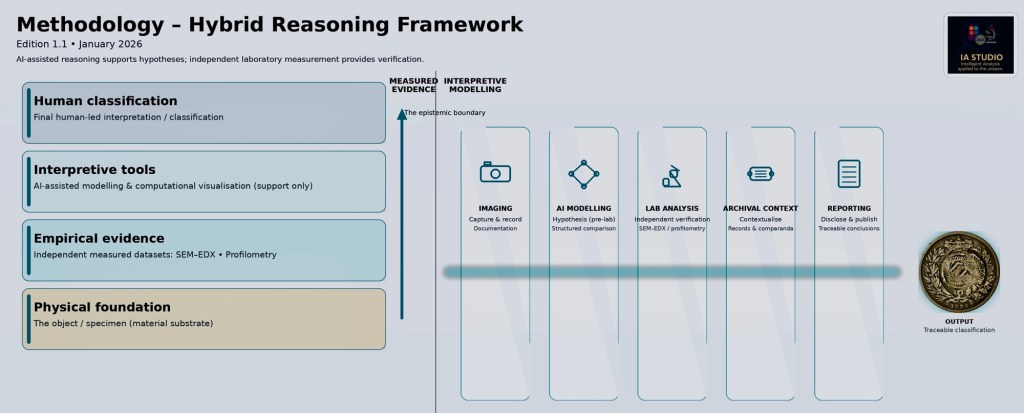
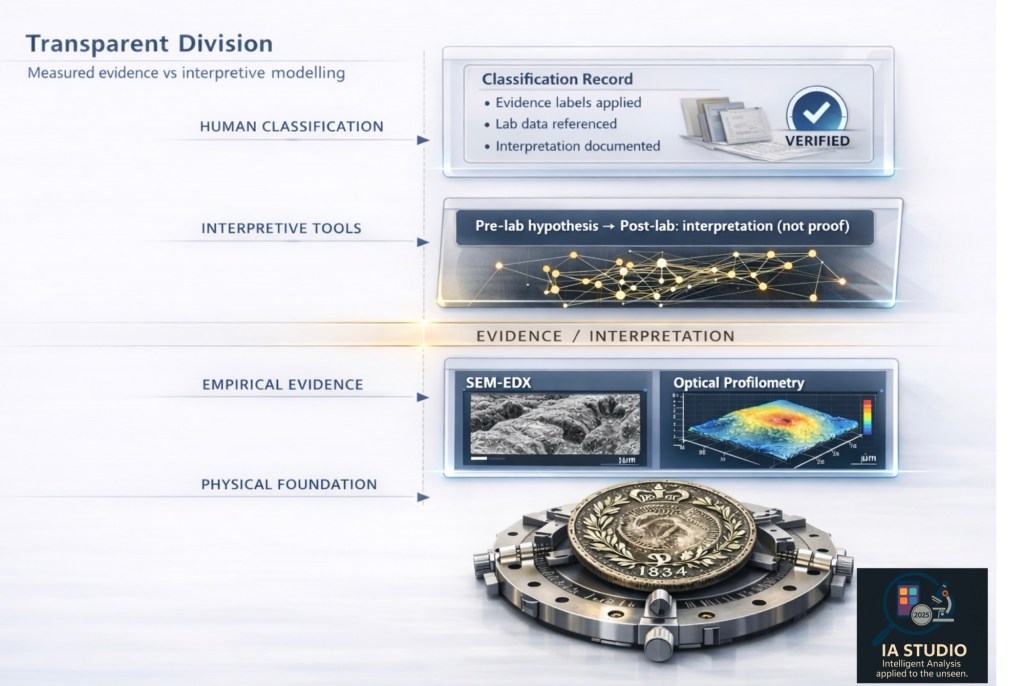
Figure (concept): IA STUDIO Hybrid Reasoning Framework (Edition 1.1, Jan 2026) – separating measured laboratory evidence from interpretive modelling to produce a transparent, traceable interpretation. (Illustrative.)
The IA STUDIO Hybrid Reasoning Framework provides a structured method for integrating computational analysis with independently produced laboratory evidence in cultural-heritage research.
The framework defines four distinct evidential layers:
- Measured laboratory evidence
- Documentary evidence
- Interpretive computational tools
- Human-led interpretation and classification
Independently produced laboratory measurements form the primary evidential foundation. Computational and AI-assisted tools are used in a supervised, exploratory capacity to support comparison, visualisation, and hypothesis formation. They do not constitute validation.
By maintaining an explicit boundary between measurement and interpretation, the framework ensures traceability between hypothesis development, laboratory analysis, and final classification.
Key takeaway
AI is not a replacement for the laboratory — it’s a bridge to it.
In this framework, AI-assisted tools are used only for supervised exploratory work (structured visual review, anomaly mapping, and hypothesis drafting before lab access; and interpretation support after measurement). Empirical validation comes exclusively from independently produced laboratory datasets (e.g., SEM–EDX; optical profilometry).
Evidential Structure
The framework operates through four explicitly differentiated evidential categories:
Measured laboratory evidence – Empirical datasets produced through independent scientific procedures (e.g., SEM–EDX; optical profilometry).
Documentary evidence – Archival comparanda, mint records, catalogues, and contextual historical sources.
Interpretive computational tools – Digital modelling, image analysis, and supervised AI-assisted visualisation used for exploratory comparison and hypothesis formation.
Interpretation and classification – Final human-led analytical conclusions integrating all evidential layers.
Laboratory measurements constitute the primary evidential constraint. Computational tools support structured reasoning but do not provide validation.
Purpose
The framework was developed to:
- Integrate computational tools into heritage research without displacing empirical measurement
- Maintain explicit separation between exploratory modelling and laboratory validation
- Provide a documented reasoning structure linking hypothesis formation, measurement, and reporting
Its function is procedural rather than technological. It does not introduce new instrumentation; it formalises evidential hierarchy within multimodal workflows.
Core Principles
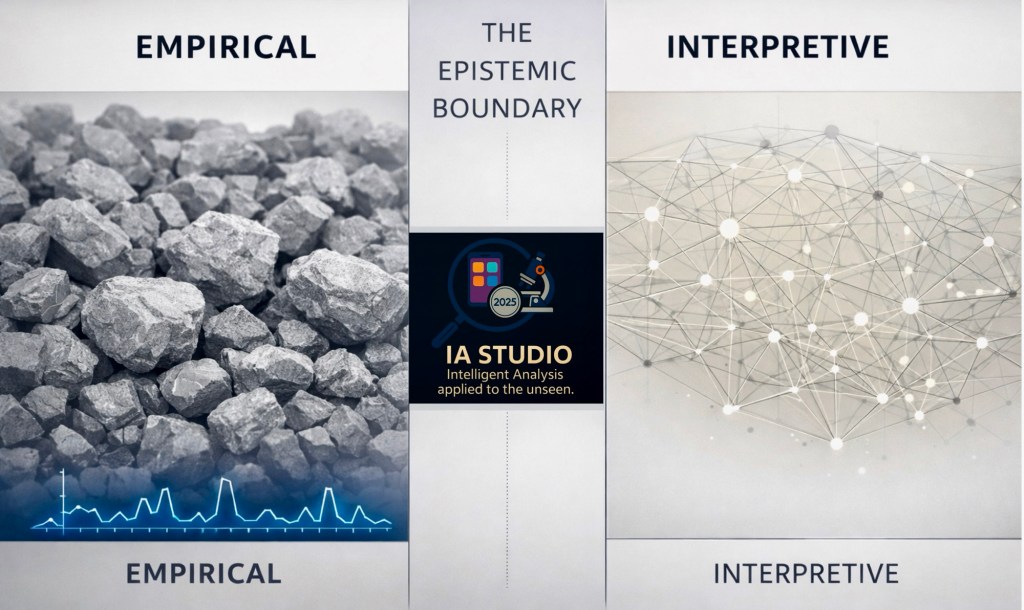
IA STUDIO distinguishes clearly between:
Empirical evidence – measured outputs from validated laboratory procedures
Interpretive tools – digital or computational methods that support reasoning, comparison, or visualisation
Figure 1 – Evidence / inference boundary
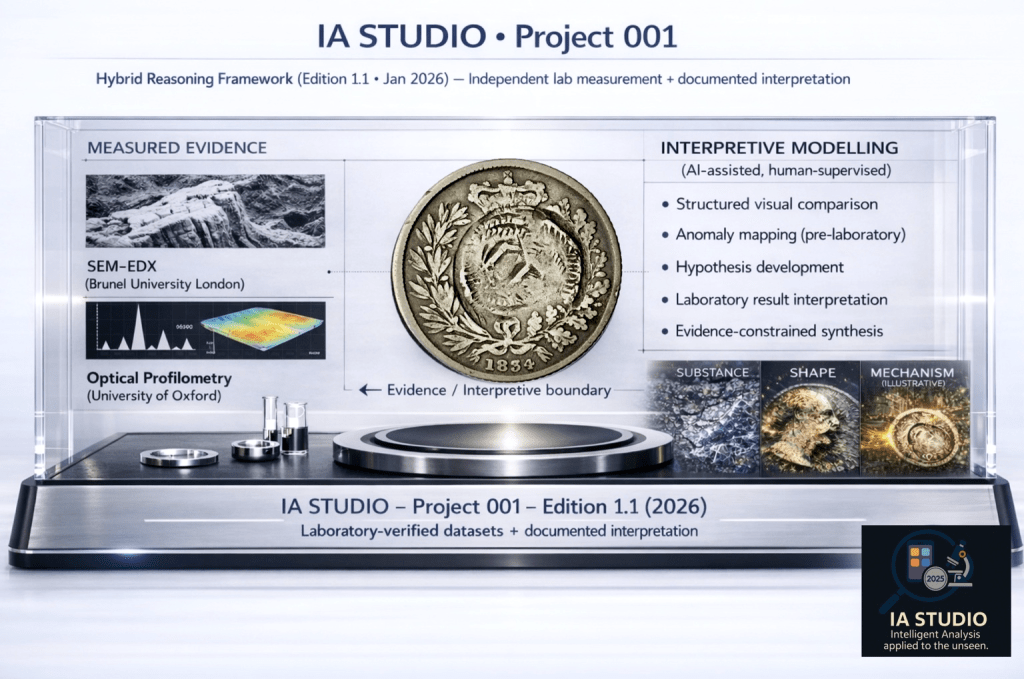
Illustrative only; not a measurement output and not evidential material.
Interpretive tools may enhance clarity and consistency but do not replace laboratory data or constitute validation on their own. All conclusions remain grounded in independently produced measurement datasets.
Workflow Stages
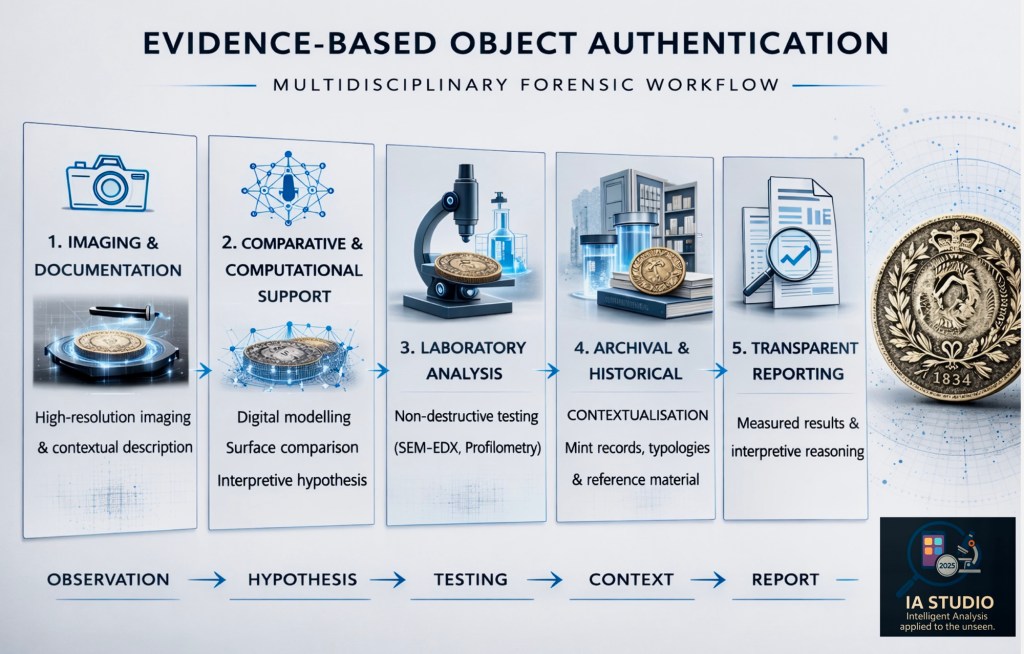
Figure (concept): Five-stage workflow – observation → hypothesis → testing → context → reporting. (Illustrative.)
AI-assisted analysis supports hypothesis formation and interpretation; independent measurement provides validation.
The IA STUDIO analytical workflow operates across five structured phases:
1. Imaging & Documentation – High-resolution imaging and contextual description of the object
2. Comparative and Computational Support – Digital modelling, surface comparison, and interpretive hypothesis formation (AI-assisted where applicable)
3. Laboratory Analysis – Independent, non-destructive testing using validated scientific procedures (e.g., SEM–EDX, optical profilometry)
4. Archival & Historical Contextualisation – Correlation of physical data with archival mint records, typologies, and comparative reference material
5. Transparent Reporting – Presentation of findings with clear distinction between measured results and interpretive reasoning
Pre- and Post-Laboratory Application
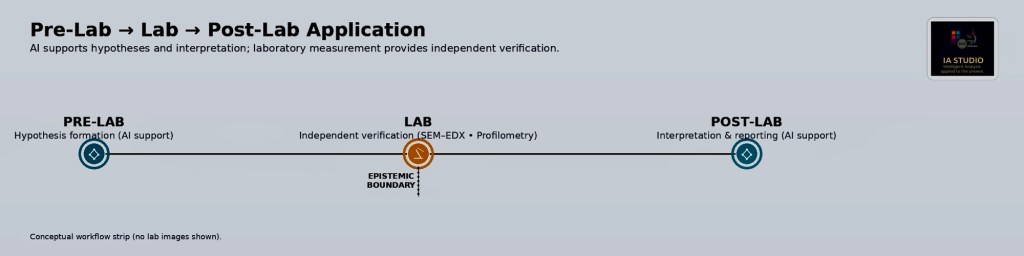
Figure (concept): Pre-lab → lab → post-lab workflow showing AI-supported hypothesis/interpretation separated from independent laboratory measurement at the epistemic boundary. (Illustrative.)
The framework is applied in both pre-laboratory and post-laboratory contexts:
– In pre-laboratory stages, it supports hypothesis formation through structured reasoning and comparative analysis.
– In post-laboratory stages, it assists visualisation and interpretation of profilometry and elemental data, maintaining consistency between digital reasoning and measured evidence.
This two-stage integration ensures interpretive continuity while safeguarding evidential integrity.
Application in Practice – Research Process & Transparency
Prior to completion of laboratory testing, IA STUDIO conducted exploratory diagnostic work combining high-resolution imaging, digital modelling, and comparative analysis, supported in part by AI-assisted interpretive tools.
These preliminary assessments informed the design of laboratory methodologies and guided analytical planning.
Following SEM–EDX and optical-profilometry analysis, a consolidated analytical dossier was prepared for curatorial review.
A condensed version was later developed for public record through the British Numismatic Society Research Blog (2025).
This progression – from exploratory diagnostics to laboratory confirmation and publication – illustrates IA STUDIO’s commitment to transparent research practice and to bridging scientific analysis with established numismatic interpretation.
A full methodological summary is documented on the British Numismatic Society Research Blog (2025).
Framework Development
The diagnostic principles that evolved into the Hybrid Reasoning Framework were first applied in early 2025 during the investigation of the 1834 sixpence.
That phase employed a structured AI–human reasoning model, integrating photogrammetry, image analysis, and comparative interpretation to develop structured exploratory hypotheses before laboratory testing.
Following laboratory analysis, which was subsequently compared with these exploratory assessments, the method was refined into a formalised framework designed to ensure reproducibility, interpretive transparency, and a clear boundary between exploratory modelling and validated scientific measurement.
While first demonstrated through a single verified case study, the framework is structured for reproducibility and intended for application across future cultural-heritage investigations.
Interpretive Reliability
Project 001 provides a documented demonstration of the framework’s sequencing. Human-led, AI-supported hypotheses and measurement targets were recorded before laboratory access. These pre-laboratory expectations were then evaluated using independently produced SEM–EDX and optical profilometry datasets. Post-laboratory assessment showed that the principal pre-laboratory observations were consistent with the measurement-constrained findings.
The case therefore illustrates how the framework supports structured exploratory reasoning while keeping confirmatory weight with independent laboratory measurement.
Illustrative concept visual — Project 001: The Witness (1834 // 2026)
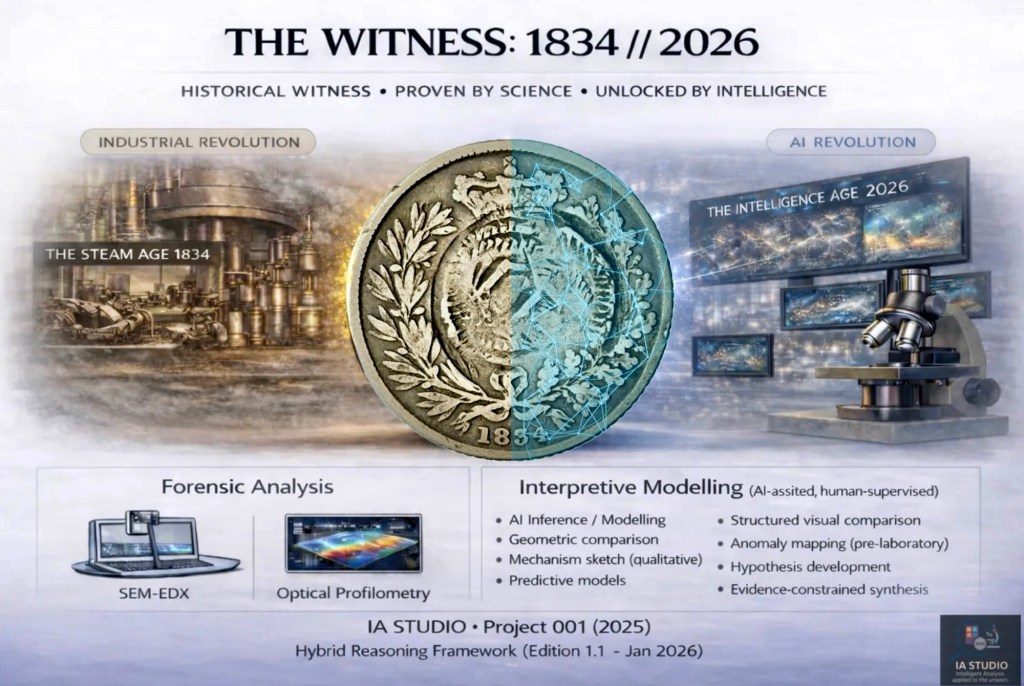
This visual was created to communicate the methodological and historical significance of Project 001. AI-assisted dialogue supported structured hypothesis formation prior to laboratory testing and assisted post-laboratory interpretation of measurement outputs. Empirical validation was provided exclusively by independently produced laboratory datasets.
Governance & non-commercial scope
IA STUDIO operates as an independent research and documentation initiative.
Any future commercial, custodial, licensing, or institutional arrangements will be considered separately under transparency-first principles.
Outputs are documented for open reference and verification and do not imply institutional endorsement.
Conclusions are grounded in independent scientific evidence and human-led interpretation.
Computational tools are used for organisational, comparative, and visual support under human supervision.
As the framework evolves, selected supporting data and workflows may be released for verification or scholarly study.
A written methods description of the framework is maintained and updated as part of this public documentation.
Appendix A – Evidence Labels (Expanded Disclosure Structure)
(IA STUDIO — January 2026)
The following appendix provides the expanded reference version of the IA STUDIO Evidence Labels system, illustrating how each evidential layer functions within the Hybrid Reasoning Framework and ensuring transparency between empirical data, interpretive tools, and final classification.
––––––––––––––––––––––––––––––––––
Measured Laboratory Evidence
Empirical data obtained through independent scientific testing.
These results form the evidential foundation for all analytical conclusions.
Example: Brunel University London – SEM–EDX (Experimental Techniques Centre, 2025); University of Oxford – Optical Profilometry (Materials Characterisation Service, 2025)
––––––––––––––––––––––––––––––––––
Documentary Evidence
Archival comparanda, minting records, catalogue or reference documentation providing historical and contextual support.
Example: Royal Mint Museum records; British Museum catalogues.
––––––––––––––––––––––––––––––––––
Interpretive Tools
Computational or visual modelling used to support reasoning, comparison, or hypothesis formation under full human supervision.
Example: AI-assisted visualisation; digital surface analysis; photogrammetric comparison.
––––––––––––––––––––––––––––––––––
Interpretation / Classification
Final human-led analytical conclusion integrating all evidential layers within the IA STUDIO Hybrid Reasoning Framework.
Example: Interpreted as a multi-strike mint-stage anomaly exhibiting characteristics consistent with retained die cap and related striking phenomena (Project 001).
––––––––––––––––––––––––––––––––––
Purpose and Context
This disclosure format maintains a transparent boundary between measurement and interpretation.
It aligns with current best practices in heritage science, materials characterisation, and responsible AI integration.
By separating empirical evidence from interpretive modelling, IA STUDIO ensures that every conclusion remains traceable, reproducible, and explicitly grounded in independently verified data.
––––––––––––––––––––––––––––––––––
The IA STUDIO Hybrid Reasoning Framework is documented here as a methodological approach developed within the IA STUDIO research programme, first demonstrated through Project 001 and intended for further testing and scholarly evaluation.
 IA STUDIO
You must be logged in to post a comment.